
Clap, Tap, Repeat: Easy Pattern Games for Preschoolers
Try playful pattern games for preschoolers with claps, taps, shapes, and toys. Help your child notice what repeats and choose what comes next.
Clap, Tap, Repeat: Easy Pattern Games for Preschoolers
Clap once, tap your knees once, then do the same pair again. You already have a pattern game. With a preschooler, the interesting moment comes when you pause and they decide what belongs next.
These easy pattern games for preschoolers use movements, drawings, or familiar toys. Choose one game, play alongside your child, and stop while it still feels enjoyable. There is no worksheet to finish or score to reach.
Find the part that repeats
In a repeating pattern, a small group comes back in the same order. In “clap, tap, clap, tap,” that group is “clap, tap.” Adults sometimes call this an AB pattern, but your child can talk about the actual actions without learning the letters.
The UK Department for Education’s early-years guidance on patterns recommends exploring simple repeating arrangements and movement rhythms, with friendly discussion when something does not fit. Children vary in how readily they notice patterns, so begin with a version you can enjoy together.
Game 1: Leave room for the next move
- Choose two comfortable actions. Try clapping and gently tapping your knees. You can also wave and touch your shoulders, or point to two large pictures.
- Show the whole repeating group several times. Say the action names as you do them: “Clap, tap; clap, tap; clap, tap.” Keep the pace slow.
- Invite your child to join you. Doing it together is a useful first turn. They do not have to watch silently and then perform alone.
- Pause after a clap. Ask, “What comes next in our pattern?” Wait for a movement, a word, or a point. If needed, do another complete pair together.
If your child keeps clapping, describe what happened without turning it into a test: “We made lots of claps. Shall we put our tap back after each clap?” They may simply want a clapping game today.
Game 2: Give the pattern a picture
Draw three large circles and three large squares in a row, alternating the shapes: circle, square, circle, square, circle, square. Point along the row together. Cover the final square with your hand and invite your child to show or draw what would fit there.
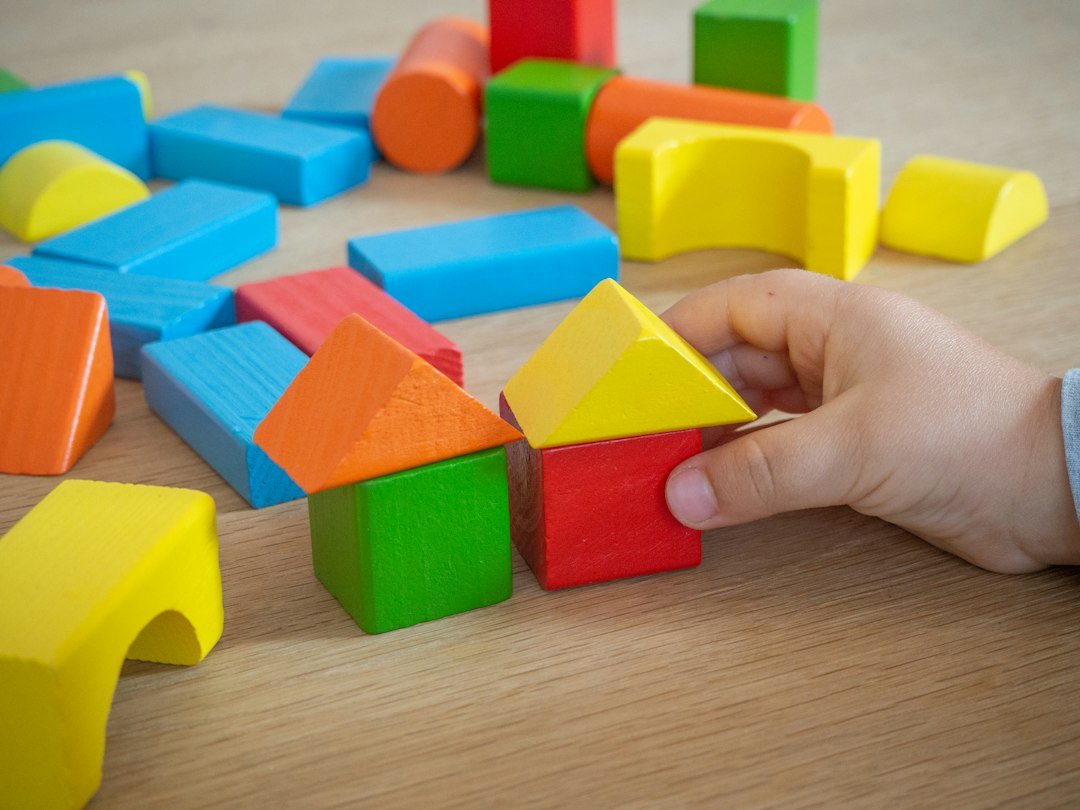
For a toy version, use large, age-appropriate blocks with two clearly different features. Keep the other features as similar as possible. If your rule is color, avoid simultaneously changing shape and size. Keep small pieces away from children who mouth objects, and stay with your child during play.
A useful question is, “Which little group keeps coming back?” Sweep your finger under one circle-square pair, then the next. This draws attention to the repeating group instead of only the final item.
Game 3: Let your child teach you
Invite your child to invent a short pattern for you to copy. Ask them to repeat it so you can see their rule. If the sequence changes each time, describe the movements you notice and enjoy copying them; you can return to a repeating version another day.
When the two-action game feels comfortable, offer “clap, clap, tap; clap, clap, tap.” Keep the whole three-action group intact. A longer pattern is an optional new puzzle, not a level your child must reach at a particular age.
NAEYC and NCTM’s early-childhood mathematics position statement includes modeling and discussing patterns among its teaching strategies. Asking your child to explain, point, or demonstrate gives you more to notice than a quick right-or-wrong answer.
Sorting, patterns, and shapes: keep the goal clear
Putting all the circles together is sorting. Arranging circle, square, circle, square in order makes a repeating pattern. Both are worthwhile activities. If your child prefers making groups, try our simple sorting game for preschoolers and come back to the row later.
If the shapes themselves spark questions, our shape games with turned squares offer another way to explore them. You do not need to teach every idea in the same sitting.
End with something you noticed
Try, “You checked the pair before adding another square,” or, “You made a pattern I could copy.” Specific observations keep the conversation about your child’s choices. A few relaxed turns can be enough for today.