
What to Say When a Child Says “I Can’t Draw”
Respond to “I can’t draw” with a smaller starting step, a choice of support, and comments about the process rather than a perfect finished picture.
What to Say When a Child Says “I Can’t Draw”
When a child says “I can’t draw,” acknowledge the difficulty and offer a smaller first step. Try, “Starting feels tricky. Would you like to make one mark, watch me try on my own paper, or tell me your idea first?” Avoid taking the pencil and finishing the child’s picture unless that is the help they specifically want.
Find out what feels difficult
The child may not know how to begin, may want a realistic result, or may simply be tired. Ask one question: “Which part feels hard?” Listen before suggesting a solution. If they do not want to explain, offer a pause rather than another question.
| The difficulty | A response to try |
|---|---|
| “I don’t know what to draw.” | Offer two starting ideas: a place or an imaginary creature. |
| “Mine doesn’t look like that.” | Ask whether they want to copy one small feature or make their own version. |
| “I made a mistake.” | Offer a choice: keep the mark, change it, or start another sheet. |
| “You draw it for me.” | Ask whether they want a demonstration on separate paper or a shared picture. |
Separate exploring from following a model
Sometimes a child wants instructions for drawing a recognizable object. At other times, they want to explore marks, colors, and ideas. Both situations call for a clear invitation. Say whether today’s drawing has a model to follow or is open-ended.
NAEYC’s guidance on supporting creativity distinguishes process-focused art, where children explore without a predetermined result, from product-focused work. It also describes conversations about materials and children’s ideas as opportunities for language and literacy. The suggestions here apply that distinction; they do not guarantee a change in confidence or skill.
Three original low-pressure invitations
These are original activity ideas, not descriptions of pages included in a particular book.
- A line with a destination: invite the child to draw a winding path. They can decide where it goes afterward.
- A tiny detail: instead of drawing a whole animal, begin with one ear, a footprint, or a patch of fur.
- A shared scene: agree who draws which part. One person makes the sky; the other chooses what belongs beneath it.
Keep your example on your own paper so the child can accept, adapt, or ignore it. If you share a page, ask permission before adding to their marks.
Comment on decisions, not a score
Notice something specific: “You used short lines for the grass,” or “You changed the path to go around the pond.” Invite explanation without guessing what the picture means. A child can also choose not to talk about it.
For teachers, avoid comparing one child’s result with another’s. Offer the same materials with different entry points: marks, a detail, a full scene, or a spoken plan.
A book is optional, not a requirement
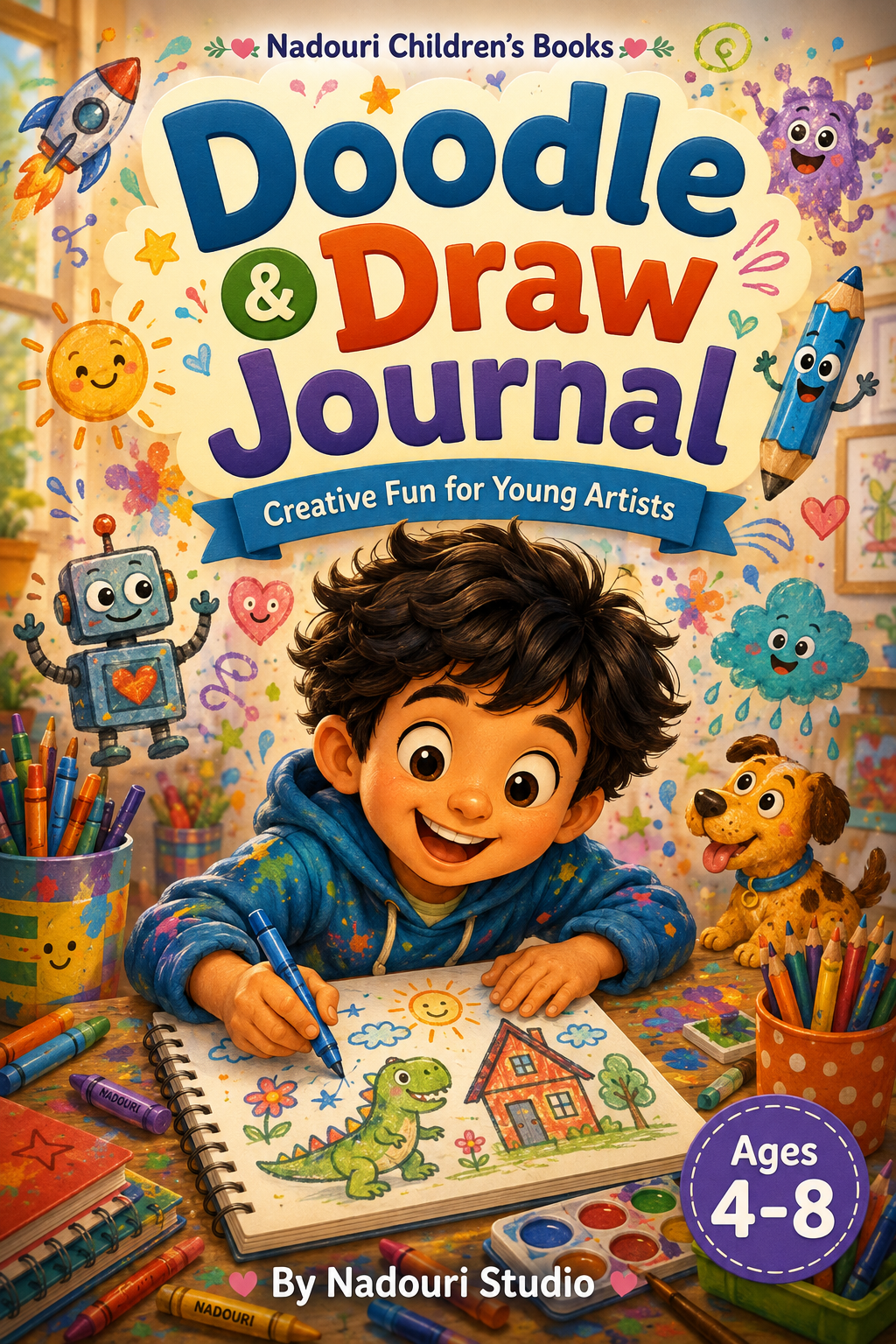
The Doodle & Draw Journal listing describes guided drawing prompts and space for ideas. Check its current previews for fit, or browse the Activity & Coloring collection. Plain paper is enough for every original invitation above.
End with the child’s choice: save the picture, continue later, or put it away. The next step can be one mark—not a finished masterpiece.