
Why Is a Turned Square Still a Square? Shape Games for Preschoolers
Help preschoolers recognize shapes beyond a familiar picture using turning, tracing, and matching games that focus on sides and corners.
Why Is a Turned Square Still a Square? Shape Games for Preschoolers
A square stays a square when you turn it because its sides and corners do not change. To help a preschooler see this, rotate one large paper square slowly, trace its edge together, and compare it with the same square in its starting position. Focus on what remains the same rather than asking the child to memorize another label.
Look at features, not just a familiar picture
A square has four equal straight sides and four right-angle corners. A triangle has three straight sides and three corners. Turning either shape changes where it points, not what it is. You can use everyday words such as “sides” and “corners” without expecting a child to use formal vocabulary immediately.
NAEYC’s Everyday Shapes guidance encourages families to compare shapes, name their features, and explore them during daily activities. The games below are original suggestions for practicing those comparisons; they are not copied lessons or activities promised inside a product.
Try the turn-and-check game
- Draw a large square on paper. An adult can cut it out, or you can rotate the whole sheet.
- Trace its four sides with a finger and touch each corner.
- Turn it so one corner points upward. Ask, “Did a side disappear? Did we add a corner?”
- Turn it back and explain: “The square moved, but its shape stayed the same.”
If the child calls it a diamond, acknowledge the resemblance: “People sometimes use that word for how it looks. This one still has the same four equal sides and square corners.” Not every diamond-shaped drawing is a square; use the actual features of the example in front of you.
Two more original games
Match across a turn
Draw two identical triangles on separate sheets and rotate one. Offer a circle as a distractor. Ask which drawings have the same shape, then trace the three sides to check. Later, try triangles of different sizes or with different side lengths; each is still a triangle if it has three straight sides.
Compare the picture with the object
Draw a rectangle beside a closed book. Explain that the book’s front face looks rectangular, while the whole book has thickness. This keeps a flat shape distinct from a three-dimensional object.
Make the challenge fit the child
Begin with two choices and let the child point instead of naming. If a rotated shape is confusing, physically turn it back together. For a group, give each child a turn to describe one feature rather than race to answer. Stop after a few comparisons; there is no required number of correct responses.
Use books as a starting point
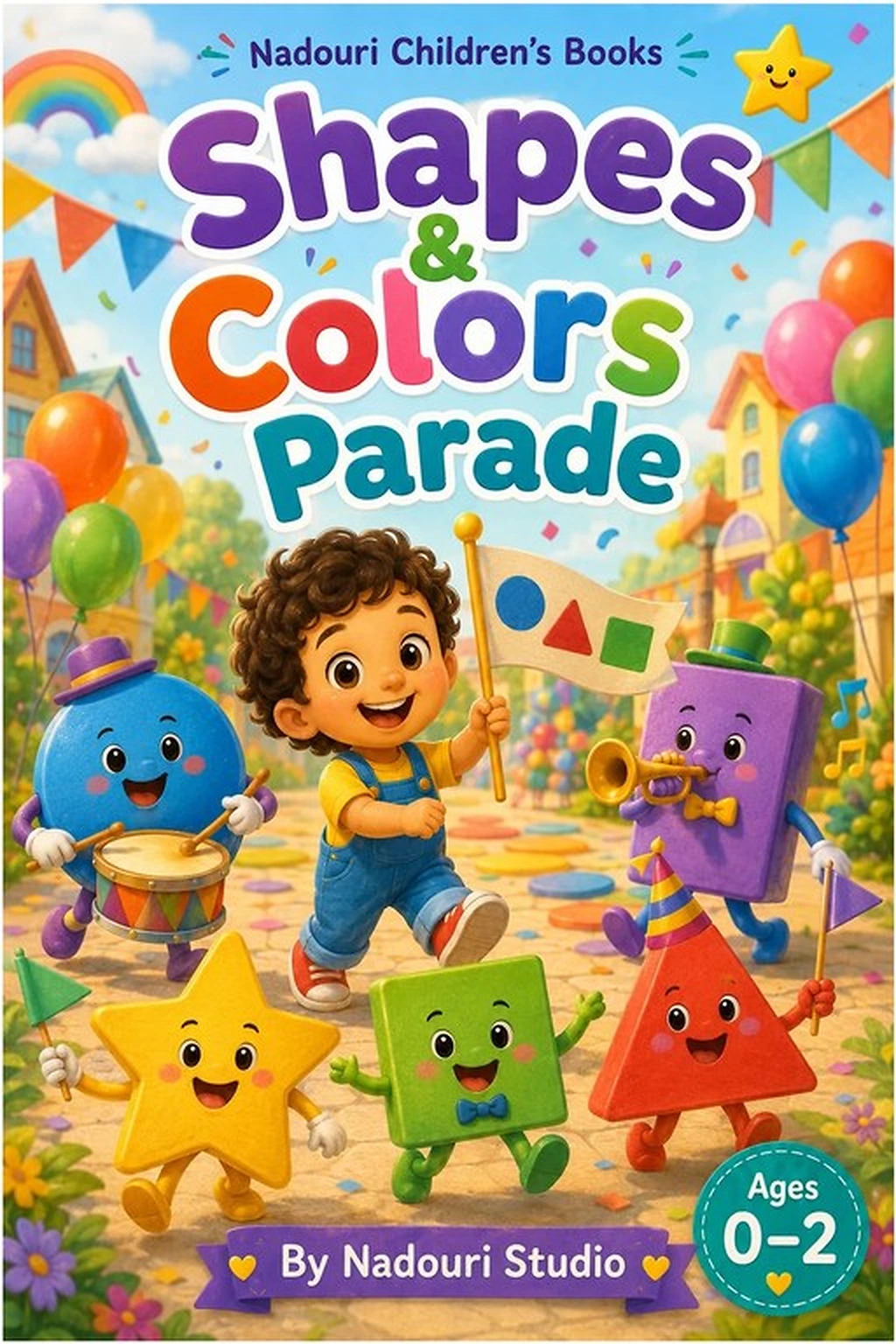
Shapes & Colors Parade is listed as a read-aloud title for babies and toddlers ages 0–2. It can be a simple shared introduction for younger family members; the preschool games above are separate extensions, not claims about its contents. Browse the Early Learning collection for other options, and check each book’s previews and age guidance.
For today, use just one square. Turn it, look carefully, and let the child explain what changed and what did not.