
How to Help a Preschooler Solve a Maze Without Giving the Answer
Help a preschooler work through a maze with finger tracing, simple route language and small hints that preserve the child’s chance to solve it.
How to Help a Preschooler Solve a Maze Without Giving the Answer
To help a preschooler solve a maze without giving away the answer, make the page easier to read, ask the child to choose the next direction, and offer one small hint at a time. The goal is not a perfect line. It is a calm chance to notice a route, make a choice and try again.
First, check whether the maze is the right difficulty
Look for a clear start and finish, wide paths and only a few decision points. Ask your child to point to both endpoints before beginning. If the page is visually busy, cover the lower half with a blank sheet and reveal it gradually.
Stanford DREME’s guide to choosing and adapting math games recommends watching a child’s reactions and changing an activity when it is too easy or too difficult. Its suggestions include breaking a hard activity into parts, modeling, using gestures and rephrasing directions. Apply that principle to the maze rather than insisting that every page must be completed as printed.
Use a finger before using a pencil
- Name the task: “We are helping the traveler reach the castle.”
- Trace from the start: Let the child move one finger slowly along the path.
- Pause at a choice: Ask, “Which way could we try?” rather than pointing to the correct route.
- Check a dead end: Say, “This path stops. Where can we go back to make a different choice?”
- Add the pencil last: Once the route makes sense, the child can trace it on the page if the book or printable is intended for writing.
DREME’s space-and-place conversation example encourages adults to ask open follow-up questions and explore how a child is thinking, including after an unusual answer or mistake. A maze offers an everyday setting for that kind of route conversation.
Give the smallest useful hint
| What you notice | Try saying or doing |
|---|---|
| The child cannot find the start. | Point only to the start symbol and ask where the traveler needs to go. |
| The whole page feels overwhelming. | Cover part of it and work on one visible section. |
| The child keeps entering the same dead end. | Place a small removable paper marker at that turn and ask what other choice remains. |
| The child asks you to do it. | Model one decision on a different path, then return control. |
Three original maze extensions
These suggestions were created for this article; they are not claims about activities included in a particular book.
- Tell the route: After solving, invite the child to describe the journey using words such as turn, around, beside or through.
- Build a floor maze: Make two or three wide lanes with cushions or paper. Let a toy travel while the child gives directions.
- Design one choice: Draw a start, a finish and one fork. Ask the child to add a short dead end and test the route with a finger.
When should you stop?
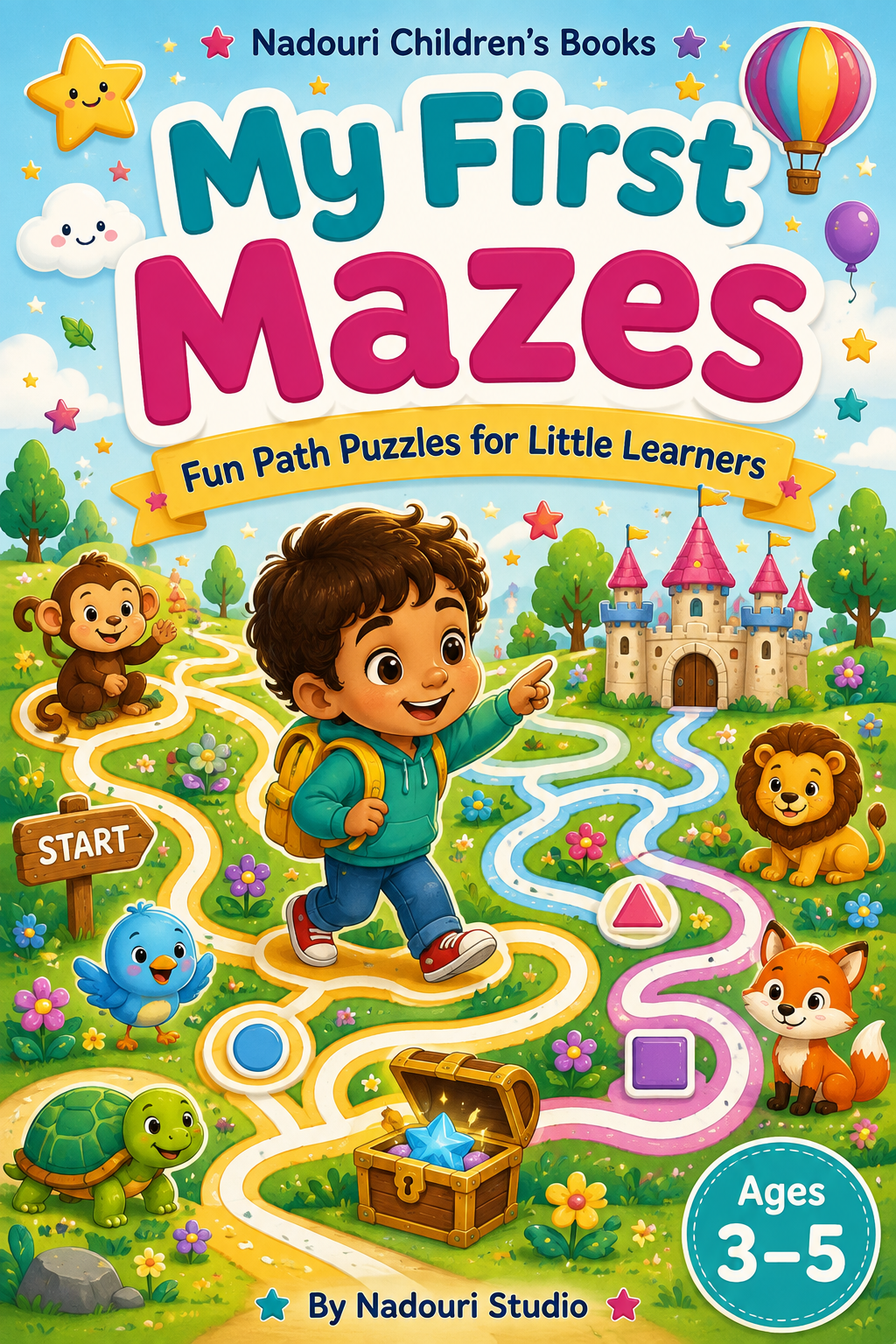
Stop or switch pages when frustration continues after you simplify the task. Finishing later is fine. The current My First Mazes listing describes wide, simple paths for ages 3–5; inspect the previews to judge whether the page suits your child today. You can also compare other options in the Activity Books collection.